
On this page
Eddy Currents Cannot Be Bypassed
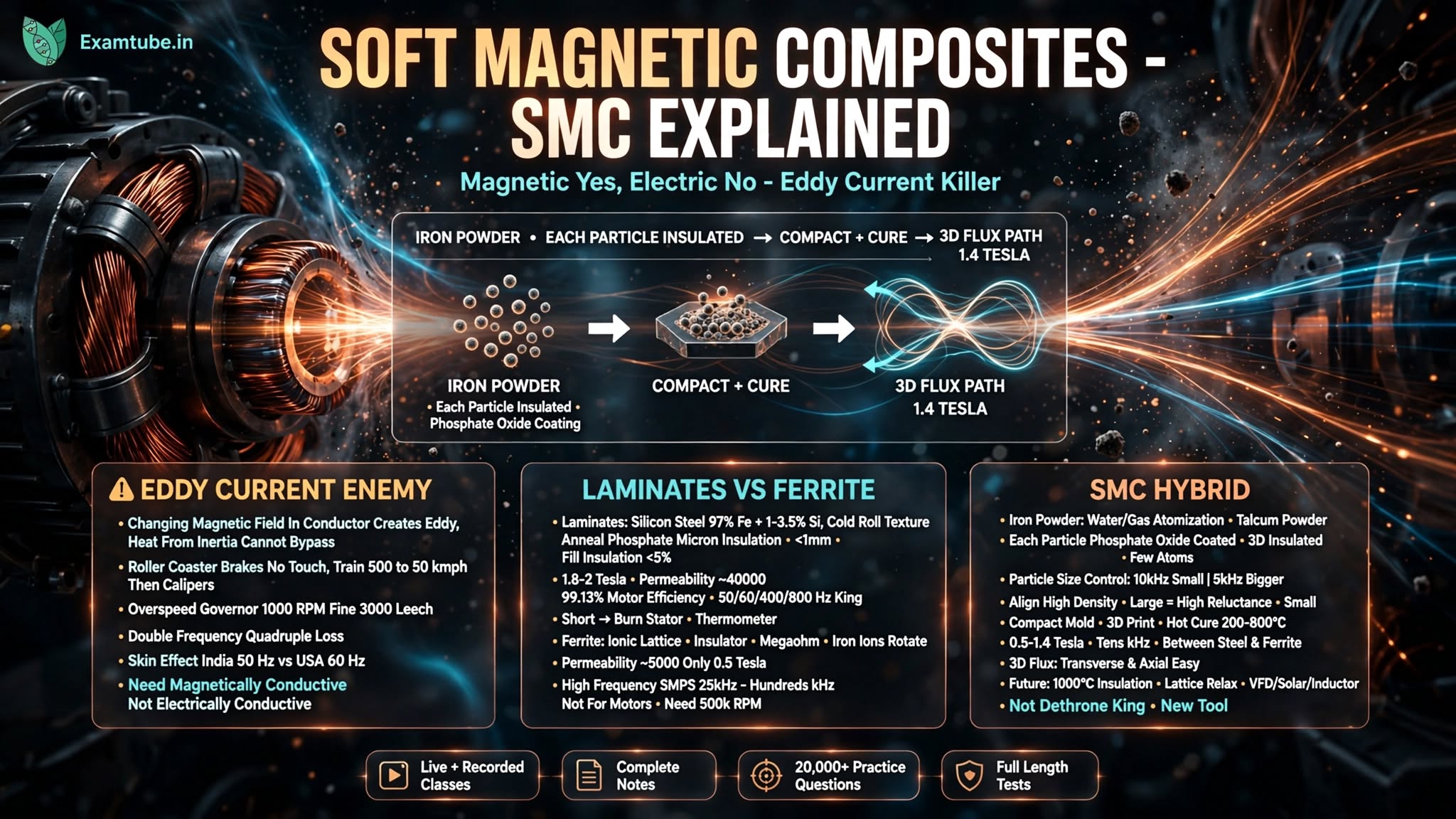
- Need is electricity, naughty puppy is eddy currents, consequence of conductors.
- As long as there is change in magnetic field, eddy currents happen.
- It cannot be bypassed, there is no cheat code around it.
- Superconductor can bypass resistance, it cannot bypass eddy currents.
- Higher the frequency, rate of change, worse the eddy current gets.
- Double the frequency, quadruple the losses.
- We need magnetically conductive without being electrically conductive.
Copper Block, Magnet, And Fight Only When You Change It
Why the heck we need this magical product property? Well, need is electricity as this naughty puppy known as eddy currents. And it is the consequence of conductors. Basically, if you have a conductor, it will happen and as long as you change magnetic field. For example, it does not have to be magnetic. Let me be very clear. As long as there is change in magnetic. For example, you have a copper block and you have a magnet there.
It is not going to care. It is like, bro, me chill. But if you change it, basically either pull or push, then it will change. Fight. You see? It is fighting it. Why it is fighting it? Because of magnetic field. Why? Because magnetic field changed. Not magnetic field itself, it does not do anything. If you change it, either remove it or add it, then it creates that eddy current, so to say. And it cannot be bypassed. There is no cheat code around it.
Heck, you can bypass a resistance by utilizing superconductor. You cannot bypass this puppy. Like this is so absolute that we use it for brakes of roller coaster. They just have a thick copper brake, so to say. And where they need to arrest the speed and they are like, okay, it has to slow down. They just have permanent magnet there. No electricity required, no activation needed because if you slowly write it, which they do when they are pulling it up, same this is the brake space and they are slowly pulling it up, it does not care because it only cares about change.
If change is slow enough, it does not give a damn. Now, when it is returning, it is going. This is like, bitch, please. That is the whole point of this. It is like the moment you change things quickly, it will create eddy currents. Eddy currents will create heat and energy cannot be not created not destroyed. That means heat came from somewhere. Your inertia was converted into heat.
High-Speed Trains, Overspeed Governor, And Skin Effect
Back in the older days where electronics were not that good and regenerative braking was not that good, high-speed trains were utilizing this sort of eddy current brakes. It looked literally like a disc brake. The idea was at high speed, like you know, 500 kmph to 50 kmph, you apply eddy current brake and to stop the train you utilize normal calipers. Now we do the same thing with basically regenerative braking.
So it cannot be bypassed and you can, oh, what if I have this alloy? It is like no, all of them will have this. Copper, iron, nickel, as long as conductor, as long as you have changing magnetic field, this will happen. And higher the frequency, basically rate of change, the worse the eddy current will get. That is why I said like if you are slowly pulling it. Like for example, this sort of systems are also used as a over speed governor.
Meaning if you have something that is spinning, you will tune it in a such a way that it is like, hey, if my propeller or something is spinning, let us say 1,000 rpm, it is fine, it is dandy. The disc would be warm, nothing serious. But what if the propeller starts to go 2,000, 3,000? Then it is like, whoa, whoa, whoa. It will leech energy on its own. Like you do not need microcontroller, you do not need anything. It will leech it and it will not physically touch it. So if it is a open dusty environment, it does not give a damage. Like it works perfectly.
So, higher the frequency, higher the rate of change, the worse it gets. That is why we cannot utilize thick puppy blocks in transformer. We used to do that, but our transformers were very inefficient. Why? The rotor, basically the core, was heating up. Why it was heating up? Because they were creating eddy currents in there. The magnetic field of AC line hurts is 50 times. It is changing. Boing, boing, boing, boing. So it is creating giant current loops.
Slice It, Insulator Makes Loop Loop On Itself
So there is a cheat code here. The cheat code is you cannot eliminate this. But if you have insulator between each of the slices, it will make the loop loop on itself. Because again, it cannot conduct, right? Like if there is an insulator, it cannot conduct. Electricity requires conduction. So, because it is a property of conductor. What if the conductor was small? So, that is the whole point. You slice it. Now, do you get the same efficiency? Yes, actually you get higher efficiency because it is a lining up the flow path is lining up. But eddy losses are very minimal.
Before this, you could see like very very older encyclopedias have photos of early transformers. It looked like stupid. It is like, yeah. They were not using laminates. It took time. Like 15-16 years of time. And again, that is why you whenever you see AC transmission line, they never use a giant cable. They always use five six smaller cables because of skin effect. Basically, the conductor itself is fighting itself. The center of the conductor is electron-less. There is not that much electricity flowing. Outside, a lot.
And that skin becomes thinner and thinner and thinner if you increase the frequency. For example, India, we can transmit further than America. Why? We are at 50 Hz. America is at 60 Hz. So, higher frequency, smaller the skin it gets. Meaning, same conductor, same manufacturer, same conductor. Let us say 【entity-ABB¦canonical_name=ABB】 or 【entity-Siemens¦canonical_name=Siemens】. They give the same transmission line in America, it will transmit little bit less. And what is the ratio of power loss? Double the frequency, quadruple the losses. So, higher the frequency, worse this becomes.
And if you are like, okay, what if I have a motor? What if I have a VFD? And what if I go YOLO on it? Yeah, it will become bad. So, we need something that can deal with this mess. We need basically magnetically conductive without being electrically conductive.
Laminates: Silicon Steel King, 1.8 【entity-Tesla¦canonical_name=Tesla】
- First proper solution was steel sheet laminates, 99.99999% time you deal with laminate.
- 50 Hz, 60 Hz, airplanes 400 Hz, EV motor primary 400 Hz, some 800 Hz max.
- Make as thin as possible, insulate both sides, break conductor path.
- Silicon iron, 1% to 3.5% silicon, 95% to 98% good is black magic, top secret.
- Hot rolling, cold rolling, texture annealing aligns crystal lattice.
- Phosphate layer, micron level, invisible, multimeter says insulator.
- Can do 1.8 【entity-Tesla¦canonical_name=Tesla】, touch 2 【entity-Tesla¦canonical_name=Tesla】, newer crossing that, MRI level flux.
- Motor only breaks by bearings or insulation, shorted plates burn motor in minutes.
- Motors 99.13% efficient without superconductor, superconductor makes it small.
- Plates less than millimeter, insulation filling never exceed 5%.
Silicon Steel, Cold Rolling Noise, And Texture Annealing
So, first proper solution was steel. Basically, sheet laminates, which we call it. Basically, 99.99999% of time you are dealing with this laminate. 50 Hz, 60 Hz, or high-speed puppies like, you know, airplanes, they are at 400 Hz. All the rotation machine in aircraft are 400 Hz. The electric vehicle motor primary frequency is at 400 Hz. Some are higher, but generally they are 400 or 800 maximum. So, at that point in time, if you are under that frequency, the laminate is your guy.
Now, we make it as thin as possible, and we insulate it on both sides. Let them get laminate, insulation, insulation. You are not giving a conductor path to short out. Eddy current requires conductor. You are breaking it with the insulation. So, what do we use? Well, we use silicon iron. Generally 1% to 3.5% of silicon. Now, let that be very clear. This is a default technology every country has that. However, going from like 95% good to 98% good, that is the black magic technology. Meaning, this number and other special sauce, top secret. Like, you will be shocked how top secret that is.
So, silicon is the silicon steel. That is why I generally will use that term. It is created. Now, you roll that puppy. Exactly like how you roll steel material, but you also do cold rolling. Now, cold rolling introduces noise into the crystal lattice. The lattice are there, crystals are there, but their magnetic alignment is like random. Random alignments will fight it. Meaning, if the natural alignments are not in same direction, it fights you. Whenever you are changing magnetic field, it fights you.
So, we do texture annealing. You do hot rolling, you do cold rolling, and then you do texture annealing. Meaning, you cook it again. And that cooking is the final sauce that allows all the crystal lattice to behave that they are almost like magnetically sorted. They are like, chill, brother. They are not random too much. They have a subtle, very subtle alignment to set. It is not strong enough that it becomes magnetic, but it is there. That relaxation actually makes this very good.
Phosphate Layer, 1.8 【entity-Tesla¦canonical_name=Tesla】, And Smaller Motor
And then we apply black magic to it, known as phosphate layers generally. Ask a chemist how the heck we deal with this. So, there is a phosphate in a binder that allows us to have a liquid-like coating on these things. And that coating is in micron level, meaning you cannot see it. It is invisible, but it is there. You can take a multimeter and try to probe it. It is like, nope, insulator detected. So, both sides are coated in insulation.
Now, this puppy, why we go through this much hassle? This has density advantage, meaning if you wrap a coil around this sort of laminate, how much magnetic lines can you funnel through it? This puppy can easily do 1.8 【entity-Tesla¦canonical_name=Tesla】. It can even touch two 【entity-Tesla¦canonical_name=Tesla】. Some newer designs are even crossing that. To give you a context, that is your MRI level magnetic flux, meaning if you have to guide flux, not generate it. MRI use superconductor for generating it. But if you have a source like, you know, current going through a coil, this is like, I got this.
Brother, I got this. Me good. This puppy can like good. And why does that matter? That means your motor is smaller. Because if you have like this number is not that high, your coils have to focus through a much bigger slot, bigger tooth. And basically, if you have a lot of pressure, small thing can do things. If you do not, you have to have larger area to do the same work, same thing. You want this 【entity-Tesla¦canonical_name=Tesla】 number to be as stupid high as possible. Laminates are daddy in this.
Laminates Can Short Out, Bearings Or Insulation Breaks Motor
Now, be mindful laminates can short out. Yes, they are almost. That is why I keep saying motor only has two things that breaks, bearings or the insulation. Laminates have that insulation. For some example, every time it is expanding, contracting, expanding, contracting, whenever your electromagnet is turning on and off, it might erode. Like, some might have a nick that might short it. The moment two plate shorts, it creates a bigger eddy loop. That heats up. That degrades the insulation.
Then those plates and lo and behold, in few minutes, it can burn out your motor. So, that is why if you have seen like a lot of motor designs have a thermometers in the stator, that is the reason. Stator could have a short circuit, and you want to shut it down before it destroys everything. So, sheets are the daddy of everything, super easy to manufacture. Everything about this is sorted and that is why we can achieve motors that are 99.13% efficient without superconductor. And you are like, then what is the point of superconductor? You make it small.
So, sheets are the king. That is how we solve the problem of eddy currents. The plates are very thin, less than a millimeter. But you do not want to make them too thin because this is another aspect. You want conductor for magnetic flux. If there is too much insulation rather than conductor, you create a poor fill factor. You want fill factor as high as possible. If you do not have fill factor, you are wasting time. So, that is why you want to make this thin, but if you are making it thin, you want to work your ass off to make the insulation even thinner. So, insulation filling should never ever exceed like 5%. Like, if this is 100, 5% is insulation, grand total, or even less.
Ferrites: Magnetic Insulator For Kilohertz
- Anything crossing kilohertz, laminates melt like inside induction furnace.
- Loop path directly proportional to frequency, high frequency laminates cannot handle.
- Need magnetic permeability, coil to coil coupling efficiency high.
- Air is 1, ferrite 5,000, sheets 40,000, cannot beat sheets at low frequency.
- SMPS switching 25 kHz cannot touch sheets, transformer cannot work with air core efficiently.
- Ferrite works because ionic crystal lattice, iron ions free to rotate, align quickly.
- Ferrite max 0.5 Tesla, not suitable for motor, need 500,000 RPM to make sense.
- Perfect for SMPS, hundreds of kilohertz, anything better than air.
Stupid High RPM, Stupid High Frequency, Laminates Melt
So, that is the sheet part of it. It is the king right now. Then we come to ferrites. Ferrite was like a what if you have to deal with stupid high RPM? Like, RPM? Yes, stupid. Frequency? Ultra stupid. So, anything that is crossing kilohertz, basically you start talking kilohertz, not hertz. When I am talking about motors, I am generally talking like, you know, 50 hertz, 60 hertz, 400 hertz, 800 hertz. Whenever you are talking in like something that is switching thousands of time, for example, 10 kilohertz, megahertz. Yeah, at that point in time, basically, insulators would be needed, like more insulation.
If you have even that sheet itself will melt exactly like it is being inside a induction furnace. So, you cannot use that. You have to reduce the loop path. The loop is directly proportional to frequency. When you are talking about high frequency, laminates cannot handle that. That is why a laminate can help handle your transformers, can deal with a lot of things, but when it comes to high frequency, it is like, nope. You go to ferrite.
Magnetic Permeability, Low Reluctance, Air Is Dead
So, what we need is what we classify as magnetic permeability, meaning coil-to-coil, can it work? Yes, it does work. Then, why the heck we put core there? To increase its efficiency, coupling efficiency from coil A to coil B has to be high. And to make it high, you make sure the magnetic field aligns are not wasted. It is not just going everywhere. No. You want to like making love from here to here, here to here, nothing more than that. Directly.
That is why this all things are created, whole job is leach all the magnetic flux. How can it leach it? Because it is permeable. It is almost like a conductor for magnetic path. So, magnetic path goes there, like you know, how lightning tries to find the best conductive path. So, magnetic flux does the same thing. Magnetic permeability is like, come to me, papa. And then you loop it. Now, air is classified as dead. That is the worst, like you have to make it better than that. You can have two coils transferring over air, but do not be surprised when the efficiency is like 30%.
So, we have to have something that is better than that. But, it must be low reluctance path, meaning it should have enough density, otherwise you have to make coil larger. So, you have to like, you know, hey, what if you pack a lot of oomph, punch in a very small area. So, air is classified as one, ferrite is classified as 5,000, sheets are 40,000. You cannot beat sheets, but the moment you increase frequency, sheets burn up. This is like, I am the only option you have.
| Material | Permeability | Max Tesla | Best For |
|---|---|---|---|
| Air | 1 | - | Dead, 30% efficiency |
| Ferrite | 5,000 | 0.5 Tesla | SMPS, high frequency |
| Sheets - Silicon Steel | 40,000 | 1.8 - 2 Tesla | Motors, transformers low frequency |
| SMC - Soft Magnetic Composite | Between ferrite and steel | 1.4 Tesla | Mid frequency, 3D flux, inductors |
So, the moment you are like, okay, I want a SMPS that is switching frequency is like 25 kHz. Yeah, you cannot touch sheets. So, transformer cannot work with air core. I mean, like it can work, but it will waste a lot of power. So, you have to have something that is better than air, which is ferrite. Ferrite is thousands of time better. And if you keep increasing frequency, there is a crossover point where it is like SMPS is now more efficient than just raw transformer. So, we use that.
Ionic Lattice: Insulator, But Iron Ions Flip Quickly
Now, how the heck this works if this is an insulator? Like if everything is an insulator, how the heck you are achieving magnetic permeability? The trick is lattice, the crystal lattice. Here it is what we classify as ionic crystal lattice, meaning it is neutral. Meaning you touch a probe through it, does not have free electrons, so to say. It does not conduct. It is like, bro, I am insulator or megaohm resistance, something like that. So, it is locked, it is chill. Ionic lattice simply means it is chill. It is like neither positive nor negative, it is chill.
But, iron ions inside it is free to rotate. Meaning the moment you apply external magnetic field, it is just like, voila, aligns. It aligns very quickly. And because it aligns quickly, tada, now you can flux path it very quickly. Now, by the way, because it is only flipping ions, it can handle very high frequency. If you want to like, okay, what if I flip the whole domain as a whole, like not just ions in the lattice, but the whole lattice, it will be great. It will be just problem the whole thing will become conductive and then too big for the eddy current. And again, not an issue at low frequency. In high frequency, it will burn up, so that is why you use this.
It is perfect, but it is only better than air and it is at max, you are looking at 0.5 Tesla. How much oomph you can pack through a point. And Tesla, you might be like, okay, we are talking very close, right? Like, you know, 1.8 Tesla, 0.5 Tesla, that sounds close enough. The proportional gain that you have to do in your motors design would become exponential. So, that might sound little, but it is like current, the heat generation is exponential. Your motor will go from this size to this size. So, fundamentally, this is not suitable for motor.
You could see ferrite magnets in the motors, but you will never see ferrite as a laminates used in a motor, because at that point your motor has to have like stupid RPM, which I think no bearing can handle, like, you know, 500,000 RPM. At that point it will make sense, but anything below that it does not. So, it is perfectly suited for, you know, SMPS kind of environment where you are switching frequency stupid, hundreds of kilohertz, but you do not need anything better than air. So, ferrites are the second thing where we created basically a magnetically permeable insulator. So, this was our second success. It works great for SMPS, not great for motors.
SMC: Hybrid Child, Talcum Powder Coated, 1.4 Tesla
- SMC is hybrid child between sheets and ferrites, soft magnetic composites.
- What if instead of ion, whole particle was doing that, whole particle macro level.
- Every particle fully in 3D insulated, like talcum powder each particle coated.
- Start with high purity iron powder or nickel alloy or silicon alloy.
- Water or gas atomization turns into powder, same as 3D printer metal powder.
- Particle size is control vector, 10,000 Hz small particle, 5,000 Hz bigger particle.
- Phosphate layer grown, few atoms across, phosphorus and oxygen.
- Compact in mold or 3D print, hot curing 200°C to 800°C, gently heat.
- Can do 1.4 Tesla, can switch 1 Tesla in small area, handles tens of kilohertz.
- Hysteresis curve almost matching steel, but needs more kiloamps after 10 kilogauss.
Scale Up Ions To Whole Particle, Talcum Powder Idea
Then we introduced the magic, which is hybrid child between both of them, which is soft magnetic composites. Now, what if you can scale up ions? Okay, ions are switching very quickly, but ion does not have the oomph, it cannot carry enough. But what if instead of ion, the whole particle was doing that? Whole particle. Instead of micro, it is macro level. So, ion systems utilize that. Basically, what if the whole particle was a conductor? Now, you are like, wait a minute, that looks like a metal. Yes and no.
It looks like a metal, but the only difference is when you look into steel, like laminate steel, all this is gap or nothing. It is just like electrically shorted, practically speaking. Here, when you look into our electron microscope, all this is some type of phosphate or oxide, meaning there is insulation. And yes, every particle is fully in three dimension insulated. They are basically it is talcum powder, imagine that talcum powder. Imagine each particle of that talcum powder to be coated. Yes. Somebody was smoking something good, but we did that.
So, each particle has what we call coating. Benefit when magnetic fields are aligned, it has much more places for basically much more lanes for magnetic flux to pass through because instead of one ion just like it is like the whole path. Ta-da! And it will not create eddy current simply because the breaks in the lattice is not lattice, I would say break in the crystal. It is literally different insulation. So, we start with this puppy with high purity iron powder or some type of alloy, generally nickel alloys or silicon alloy.
Atomization, Particle Size, And Phosphate Layer Few Atoms Across
And we just do black magic to it known as water or gas atomization. Turn it into powder. By the way, the same thing that we use in order to make 3D printer fill powder metal powder, the same thing. We atomize it, basically turn it into talcum powder. After that, we control the particle size, basically this action will be defined. Meaning somebody is like, hey, we are dealing with something stupid. Let us say 10,000 hertz. They are like, okay. Make the particle small. Somebody is like, nah, bro. We are only at 5,000 hertz. They are like, okay, make the particle bigger.
So, ideally you want as big as possible. It is just that because of frequency you are making it smaller. So, you want to optimize it, like you know, balance it out. Particle size becomes a control vector. Some designs are so advanced that they are like, okay, we are going to align the particles. Where we want maximum reluctance inside the structure, we will pack that area with high density powders, basically larger particles. Where we want like, you know, almost high reluctance, like not as high as air but still higher, we will use smaller particles. So, that is how we do that.
Now, how the heck you create layer there? It is a chemical black magic which we call insulating phosphate layer. You grow it. You literally take the dust and you grow layer on it. And it is like literally few atoms across, so to say. Each of these points are literally few atoms across. So, we create phosphate layer, basically phosphorus and oxygen creates a layer, these layers, and each particle is literally insulated.
Compact, Cook Gently, 200°C To 800°C, 1.4 Tesla
And then you compact it. You take the powder and you got. You take a mold and you just like into it or 3D print it. So, that is how and we cook it. Now, be mindful, this is the hassle part. Everything here is great, but we do not want this to become conductor or burn out because again, that will create hot spots whenever you are using high frequency. So, we have to gently heat it up. And this is basically between ferrite and steel, so to say. So, we do hot curing. Some designs are like 200 degrees Celsius hot curing. Other designs are touching 800 degrees Celsius.
Now, how much power we are talking about? We are talking about 1.4 Tesla. Meaning this is becoming good. Like not great, but like this is good. Like 0.5 to 1.4 is like it is good. Like it can almost especially at higher frequency like it will match. Like if you have a electromagnetic coil and it has to switch between like let us say one Tesla of output versus not, it can do that. Like it can give you one Tesla of output in a small area. So, it can switch. That is the good part. It is the closest when it comes to steel performance.
And it can do it higher frequency. Basically the frequency where laminate sheet will burn up. This can handle it. Of course, it will not handle as high as basically ferrite because again, this is much larger domain for eddy current to create a havoc. But again, if you are below like, you know, tens of kilohertz, this is like I am your guy. Which I can motors rarely exist that. So, this is why everybody is looking into it.
Hysteresis Curve Almost Matching Steel, Needs More Current After 10 Kilogauss
Now, you can see like the hysteresis curve, the height is almost matching, right? It can almost touch it. But the curve basically steel, it does not care. Like you can keep pumping power. It does not fight you. It does not fight you. Once you cross like, you know, a 10 kilogauss, then it is like it starts to fight you. It is like, bro, come on. Like you traffic jam is happening. At that point you have to pump more kiloamps in order to get the coil to produce like, you know, laminates to carry more.
So, in this basically the silicon system, oh sorry, soft magnetic material, you can get there, but it will require more energy. Who the heck came up with this unit name? But like you have to keep pumping more current to do that. But you can get there. That is the good part. It can get. Ferrite will not get there. This puppy will get there. It just will take more power. But that power may not be an issue if you are talking about high frequency because at high frequency steel is like, nope. Eddy current destroys you. So, that is why soft magnetic composite is between inductors, sorry, between sheet and ferrites.
Future: 3D Flux, Not Dethroning Laminates Yet, VFD And Solar Inductors
- SMC is not ready to dethrone sheet king, no matter how much marketing.
- Motor is sorted, radial flux motor on laminate is catalog part, ABB, 99.1% efficient.
- All money burning is to make lighter, ultra high torque at ultra low RPM.
- Laminate not dethroned soon, most things not high frequency, except turbo charger energy recovery and CNC spindles.
- Before no option for mid frequency, now low, mid, high frequency tool exists.
- Cheat code is 3D flux path, transverse flux and axial flux, easy-peasy, laminates say no.
- Can be 3D printed, binder layer by layer, sinter system like 【entity-HP¦canonical_name=HP】 inkjet printer.
- Two things left: relax lattice like steel, and insulation electrically insulating but magnetically more conductive.
- Insulation stable to 1,000°C work is going on.
- Best future is VFD and solar inverter inductors, ugly spot between ferrite and sheet.
Motor Is Sorted, Laminate Is Catalog Part
So, what can we expect in the future? Well, here is the deal. SMC is not ready to dethrone basically sheet king no matter how much marketing is happening. That part is sorted. Like we good. We good. When I say motor is sorted, I mean it. Like it is sorted. Like we good. If you want to make a radial flux motor that is running on laminate sheet, like you can right now today pick up a phone and it is like, yo, my man ABB. I want a motor. It is like, okay, sir. How much budget? Yes, budget. Okay, how much efficiency? 99.1% efficient is like, yeah, take it and go. It is a catalog part. Like you can just take it and go.
Everything else, the all the money we are burning into motors, it is trying to trick something else. It is like, hey, can we make it lighter? Hey, can we make it ultra high torque at ultra low RPM? Those sort of thing. But like motor is sorted. So, laminate is not going to be dethroned anytime soon and especially most of the things are not that high frequency. Like other than turbo charger energy recovery unit which again F1 no longer uses and CNC spindles, I rarely see anything that has that sort of high RPM where it is like clear like do not use laminate, only use basically composite soft composite.
3D Flux Path Unlocks New Designs, Transverse And Axial Flux
So, but again, it is an option. Before that we did not had an option. Like unless you were going stupid high frequency, which again it will be like 5 million RPM, we had no use for it. So, now we have something that is low frequency, mid frequency, high frequency. So, that means we have a new tool to design something. Now, the reason why we are interested, if you do not need bonkers amount of torque, there is a cheat code. Cheat code is it allows 3D flux path. Meaning, if you are working on transverse flux motor or axial flux, you do need wire lines to crisscross too much. That is easy. That is easy-peasy for this. Laminates are like, no. Nope. For this, it is like, bro, that is Wednesday.
So, it is super easy. So, it could unlock new designs, especially if you do not need like bonkers amount of torque. Because again, be mindful, Tesla is lower. But, what if you do not need bonkers? But, what if you need 3D will compensate for that? It is like, desirable. And it can be 3D printed. So, basically, you take the binder layer basically binder in this powder, you lay it layer by layer. Instead of using laser, you cook it in a sinter system. It is like HP inkjet printer, so to say.
Two Things Left: Relax Lattice And Better Magnetic Conduction, 1,000°C Insulation
Now, there are work being done. I have linked the video down below where they are working on making a insulation layer that is stable to 1,000°C. Because there are only two things left. One thing is make sure we can relax the steel. Like same way we relax the steel, we cannot do that here. If we could do that, like once we have forged it and relax it, if the lattice relaxes, like you know, magnetically speaking, relaxes, it will be much better. Second, what if the insulation layer is electrically insulating, but magnetically conductive? It is magnetically conductive. It is just like, what if we improve that conduction more?
And at that point in time, maybe maybe we will finally reach where it is like, yeah, laminates are like sorted thing, like cheap motors. But, when you need like really high 3D blah blah blah and all that, then you use that. But, it is far. Let that be very clear. It is far. You do not have to worry about it today. It is far. But again, it is a interesting development. Like we have a new thing. Especially, there are lot of interesting inductor designs, especially for VFD and solar inverters. Because that inductor is in that ugly spot where it is not super high frequency for ferrite, not super low frequency for sheet metal. They need something in between. This is like, I got you. So, future is going to be interesting.
We have a new tool. You could not have talked about this in 1950s. Future is going to be interesting.

Discussion
Comments
Please log in to join the discussion.
Login to commentNo comments yet. Be the first to start the discussion.