
On this page
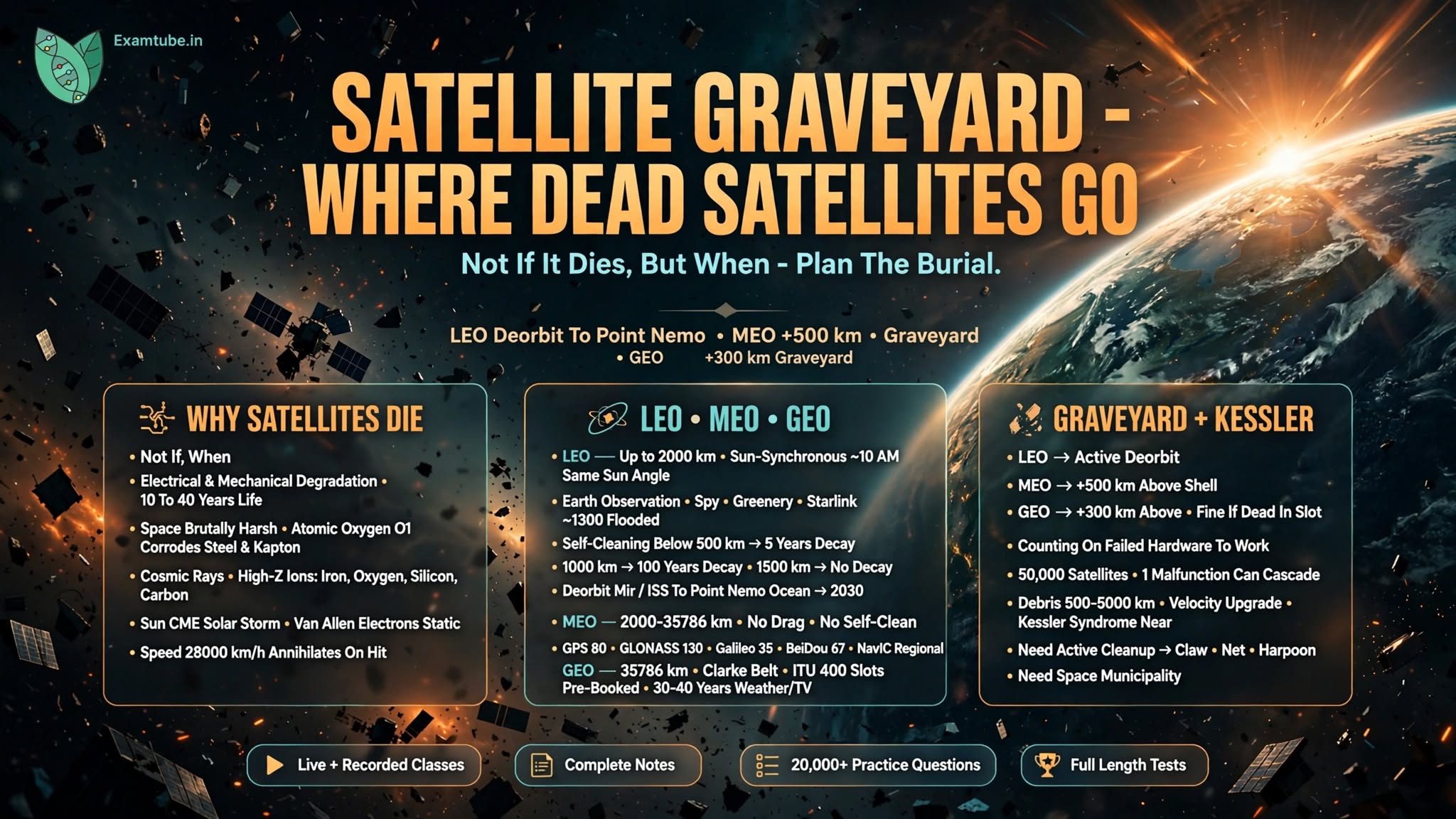
Satellites Do Not Last Forever, They Have To Be Buried
- Satellites are man-made, not cosmic or god-made, so they do not last forever.
- It is not if it is going to fail, it is how and when it will fail.
- Electrical failure, mechanical failure, and degradation all have a unique signature.
- Space is brutally harsh, and that is why everything eventually kaputs.
- A satellite may last 10 years or 40 years, but it will be kaput.
Not If, But How And When
Satellites are man-made objects. They are not cosmic objects nor are they god-made. So, meaning they do not last forever. Translation of that simply means it is not if it is going to fail, it is question is how and when. So, you can manage it. Other than that, there is nothing else. There are a lot of factors of failure, like how the heck it is going to fail, and we have to plan according to it.
There will be electrical failure, there could be mechanical failure, and there could be degradation-based systems. So, all of this will have a unique signature. And again, there are many, many, many more, but point is this is the domain of it. Like, things will kaput your satellite, no matter what you do. It is just question of when. Maybe it could last 10 years. Maybe it could last 40 years, but it will be kaput.
Like Voyager technically is working, but like, yeah, it is like from what it was to what it is, it is like, yeah, barely. So, why is that? Well, space is harsh. Like, it is brutally harsh. Like, harsh harsh kind of harsh. So harsh that the European Union once tried having a satellite at very low earth orbit, like almost where they could fire a jet engine, like almost 100 km.
Atomic Oxygen Corrodes Everything
And then they realized, yeah, you cannot put satellite there, it will corrode. Because again, they were expecting to use ion engines to keep maintaining the orbit. It is just that, yeah, they were corroding. Why? Atomic oxygen. Oxygen is reactive, right? You know that, I know that. That is O2. Its worse version is atomic oxygen, aka O1. That puppy corrodes.
Like, you have a stainless steel, it is like what stainless steel? You have Kapton tape? Gone. It is just like it does not exist. So, if you are a chemist and you are like, no, I know how to tank this, make something that can withstand this. People are like, shut up, take money.
Radiation Is A Messy Soup, Not Just Alpha Beta Gamma
And then we have radiation. Now, we do not have basic radiation like alpha, beta, gamma, and neutron. We have very different and messy soup of radiation. So, you have cosmic rays. Now, cosmic rays is assume universe is sneezing. And that generally includes protons, like full-fledged protons, full-fledged nucleus. So far, not that bad. Then you have high-Z ions. Yeah, that is lethality.
Now, high-Z ions is basically ion, basically electrons have been stripped, but it is a heavy element, aka iron, oxygen, silicon, carbon. Now, you might be thinking, okay, cannot we just stop it? These were accelerated by some big things. So, they are traveling at high speed. And when I say high speed, I mean cosmic-grade high speed. So, they are fast. And when they interact with something like, let us say you have a shield and it is like, bam. Here is the deal.
Iron will not go inside there. That is not the problem. Problem is because of that bombardment, the atom which like, let us say you have steel hull, that steel hull will dissipate energy. And to dissipate that, it might dump a neutron. I did not even knew that neutron emission is possible outside of nuclear fusion and fission or radioactive decay. This is like, bitch, please. Bam. Neutron, you die. So, yeah, that is bad. Let us just say it that way. That is bad.
And that is why we generally want to be below Earth magnetic field. Like, we want to be close to that, not outside that. Outside that, these things are there. And we might feel when I say it is low, you are safe there, relatively safe. It is not that. And again, that is why Orion, when they have to make it, they really have to work. It is like, oh, but how did they do in Apollo? They tanked it. You can tank it. It is just that nowadays we do not have a tolerance for tanking it. So, yeah, that is a bad puppy.
Sun Sneezes, Coronal Mass Ejection And Van Allen Belt
And then you also have to understand that whenever sun sneezes, now you have to know sun reaction like basically actual fusion happens in the core. Now, core is deep within plasma. Plasma is opaque to photons. So, gamma rays is like, yeah. It emits and plasma is like, bitch please. Stops it, absorbs it, rebounds it. Brick by brick by brick it is increasing the temperature of plasma, but it is losing energy.
It says it takes 10,000 years from a core to outside from mean path calculation. So, by the time it is out it is just heat. Meaning it has downshifted so much that it is not an issue. However, because sun is a big puppy, it is a magnetic field. Whenever it twists it goes, mhm. You must have seen a lot of 【entity-Discovery Channel¦canonical_name=Discovery Channel】 that shows that like, you know, it is just like almost looks like bam. It is like that snapping that bam.
Whenever that bam happens, it does fusion there. That puppy dumps gamma rays. It is not the sun reactor that is dumping. It is the sneezing of it. So, that is why whenever you keep hearing that 【entity-ISS¦canonical_name=ISS】 astronauts have to huddle in the safe pod, that is because of this. Whenever the coronal mass ejection happens, that can dump so much so quickly that it is hassle. Like you better be safe and secure.
Again, let me be very clear. You can still tank this. It is just that we do not have tolerance for tanking it. And tanking it means you might develop cancer. So, multiple tanking you did. It is like one or two things you can tank. So, this is a very hostile environment for things. And what is in Van Allen already? Way too many electrons. Like way way way too many electrons. It creates static electricity. That is how brutal it is.
I am not joking like you have to ground all the electronics. Figure out how the heck you ground something when you are floating in space. But you have to. Apollo did it too. That is how you have to deal with that. And because of the speed, the velocity, basically all the rocket energy, where did that energy go? Energy cannot be created not destroyed. So, where did that energy go? All that whoosh is in that kinetic mass.
So, that mass is now traveling at 28,000 km/h if not more. So, that sort of velocity, it does not hit something, it annihilates whatever it hit. So, you cannot ignore it. Voyager, we were lucky. We threw it. So, it is out. It is out of solar system. It is not our problem. It might hit some alien civilization thousands of years after, but like it is not our issue anymore.
So, that is a problem. We have to maintain our orbit. If we do not, we are basically we cannot have the orbital litter with corpses. We have to bury them.
LEO, Sun-Synchronous Orbit And The Self-Cleaning Lie
- LEO is lower earth orbit, from as low as you can go to 2,000 km.
- Sun-synchronous orbit photographs a slice twice, at exactly same sun angle.
- It is best earth observation system, spy satellites and greenery measurement live there.
- Starlink alone flooded LEO with 13,000 boxes, plus space stations are there.
- LEO is called self-cleaning, but only below 500 km it really cleans in 5 years.
- At 1,000 km decay is 100 years, at 1,500 km it might not even decay.
- Big objects are deorbited to Point Nemo, ISS is supposed to be pooped there in 2030.
LEO: Everybody Loves Leo
So, first puppy is LEO. Now, everybody loves Leo. Leo is lower earth orbit. Anything as low as you can do to as high as 2,000 km. Now, when I say as low, again, people are working their ass off. It is just that atomic oxygen is like please. Again, there was some designs. I am not joking. Like there was like what if we funnel the air and what if we ionize it and what if we like boost it? And then it is like they ran the simulation. They did not even like testing and all that. It is like steel. Gone.
So, it is super easy to get to. I mean like V2 rocket reached it. And sun-synchronous orbit. Now, this is a lovebird. Like everybody wants to make a love to this. Why? Because this allows you to photograph a slice of earth two times. One time it is in a sunlight, another time is shadow. Now, generally you do not want to waste battery power if photographing in shadow, but you could do that.
However, the key part is earth is spinning below you. Let that sink in. Earth is spinning below you. So, what does that mean? Every slice is at exactly the same sun angle. So, let us just say it is 10:00 a.m., right? Next slice is still 10:00 a.m. Slice after that is still 10:00 a.m. Every slice you are taking is 10:00 a.m. and you are slicing the whole planet. Meaning, if I take picture from your satellite and you have stacked it like you have made a atlas of it, I have multiple atlas, each of the shadow will line up perfectly with each other.
Meaning, even a simple algorithm can figure out like what actually changed rather than oh, shadow changed it so it is messing up the calculation. No. So, that is why people love this. Like this is the best earth observation system. And nowadays we have radar-based systems. So, that allows you to bypass atmosphere also. So, that is it. Like GG. And you while you are doing the actual observation, you are in the sun side so you are also getting a lot of solar power.
So, this is very desirable. That is why you whenever somebody is making small satellite, they will always a small satellite launcher, they will always talk about LEO and sun-synchronous orbit. Like there is a race to fill up sun-synchronous orbit. It is great for earth observation. Meaning, where is spy satellite? Generally there. Where is your earth observation satellite? Generally there. Where is like you know, for greenery measurement? There. Everything is there.
Constellation Flooded LEO After Falcon 9 And Starlink
So, we generally flood that. Now, the flooding is happening because of we want to make constellation in lower earth orbit, which was not a old idea. It is like it is a very new idea. And again, we did not want to do constellation because it would have required thousands of launch. So, for that reason, LEO had a lot of satellite but it was never a constellation base. After 【entity-SpaceX¦canonical_name=SpaceX】, after Falcon 9, after Starlink, that puppy got flooded. So, generally now we have flooded like what Starlink alone has flooded this puppy with 13,000 of boxes. So, that is bad. And all our space station is just there.
Like we do not have a space station over there. There was a talk about lunar gateway but that was cocaine. So, 【entity-Obama¦canonical_name=Obama】 cocaine. Thankfully that was eradicated. Now, be mindful whenever we are talking about lower earth orbit, you must hear this term like it was self-cleaning. Yes and no. Earth atmosphere does not go like, you know, oh above 100 km is zero. It is not like that. It is just that you have to understand it starts to fall off.
If you are at 2,000, you are not in lower Earth orbit practically speaking. Like if you are from a radio point of view, from a Earth classification point of view, a human legislation point of view, you are in lower Earth orbit. But your orbit will not behave like you have a drag. Like you must have seen like 【entity-ISS¦canonical_name=ISS】, they align the solar panels. So it like, you know, flows through the air rather than like going bam. It will reduce the it will increase drag. But if you go to 2,000, you are legally still in lower Earth orbit. But you do not have atmosphere to worry about.
| LEO Altitude | What Happens |
|---|---|
| Below 500 km | Self-cleans in about 5 years if satellite poops |
| 1,000 km | Satellite decay orbit is in like 100 years |
| 1,500 km | Might not even decay, legally LEO but not self-cleaning |
| 2,000 km | Legally LEO, practically no drag to worry about |
Like even 1,000 km, your satellite decay orbit is in like 100 years. It falls off very drastically. So generally, you want your poop to be under 500. That is why 【entity-Elon Musk¦canonical_name=Elon Musk】 rocket systems are targeting very low. Like they want to go as low as possible. If you are low enough, it could be as low as like, yeah, 5 years. If your satellite poops, 5 years later it will be ship deleted automatically.
But if you put it at 1,000, legally still in lower Earth orbit, it will take hundreds of year. At 1,500, it might not even decay. So that part is a very messy thing. So you have to be mindful and whenever you are talking about satellite actively, like it is like, yo, my life is done, I need to be deleted, it generally will deorbit. It will not do anything else. So Mir space station, Russian 【entity-ISS¦canonical_name=ISS】 so to say, they deorbited it.
Point Nemo: Where Big Things Are Pooped
Now, whenever you are falling something big like 【entity-ISS¦canonical_name=ISS】 or something like that or Mir space station, there is a spot we marked in the ocean. We do not send any ship there. It just go there and bam it. And you are like, can things survive that? Yes. Even at orbital velocity, if you are big enough like space station is what 600 tons of big modules. Enough tonnage will survive. So if you are talking about that, you want a safe space where you can poop it. So that poop place is I think Nemo, where you just poop it.
ISS supposed to be pooped there in 2030. Let us see what happens. So, you have to actively do that. And hope, if your system fails, you are low enough that atmosphere clears it out. But again, if you are at 1,500, legally still in lower Earth orbit, but it is like, no. No. Like, you if you governments will not generally give you license to launch something at 1,500. They know this. It is like, bro, I know you are saying lower Earth orbit, it is not low enough. Please reduce your orbit. You want to be in a position where you can self-clean.
MEO Is The Neglected Middle Child, GPS Lives There
- MEO is band from 2,000 km to 35,600 km, almost touching GEO.
- It has no drag, satellite there might as well be there as long as moon is there.
- It is not self-cleaning, flat out, not even calculated as self-cleaning.
- MEO 20,000 to 22,000 km is sweet spot, whole planet covered with as little as 25 satellites.
- You need 3 satellites for trilateration with atomic clock, 4th for timing if no atomic clock.
- GPS has almost 80, GLONASS 130, Galileo 35, BeiDou 67, NavIC still regional.
- Dead MEO satellites must go 500 km above shell into graveyard orbit, cannot deorbit.
MEO Has No Drag And No Real Use Except GPS
Then we come to the most neglected middle child, which is medium earth orbit. And this puppy is the band from 2,000 km to 35,600 km, almost touching GEO. So, it has no drag. Meaning, if you are above 2,000, nothing is going to happen to you. Meaning, if you put up satellite there, it might as might as well be there as long as moon is there. So, like, you good. You got this.
Of course, let me be very clear, solar storm will push it. It might change its orbit, but it is safe enough. Like, it is more likely to hit something else than it is to fall onto earth. Like, it is so much buffer room you have. So, it is not self-cleaning, flat out. It is not even calculated as self-cleaning. But it is very awkward to use. Meaning, if you have a camera, you want to be as close to your topic as possible because of inverse square law, you will get maximum resolution.
If you want to do weather and you want to see the greater picture, you want to be as far as possible. That is geostationary. This has no actual use. So, some mathematician come around us like, okay, what if we want GPS? It is like, okay, brother, how do we do that? It is like, now, geostationary, you might be thinking, hey, is not that great? You have known fixed satellite position. You can easily calculate it. It is like, yeah, but you cannot.
If you put something that is above 36,000 km, the radio signal would be very faint, very weak by the time reaching you. Same thing, inverse square law. So, you do not want your satellite to be that far. Okay, if you come at very close like lower orbit where anything can pick up your satellite signal, you would need way too many satellites. So, MEO, like 20,000 to 22,000 km, there is a sweet spot.
25 Satellites, 4 Spheres And Trilateration
At that spot, you can cover the whole planet with as little as 25 satellites. Now, what does that 25 satellite is doing? Like in geostationary, you have three each sees the whole planet. 25 in MEO does something unique, meaning all spots on Earth with a reasonable cone should have more than four satellites. Sorry. More than three satellites. You need three to do what we call trilateration calculation as long as you have atomic clock.
If you do not have atomic clock, like this puppy, you need fourth satellite. That is why you will always hear the timing satellite. You need four sphere to do the calculation. So, generally, that is why we do not launch 25. We generally go much above that, but mathematically, that is the bare minimum.
GPS, GLONASS, Galileo, BeiDou And NavIC
So, people started to cover this medium Earth orbit with constellation. So, GPS has almost 80 puppies there. Now, you are like, wait a minute. They have active 80 satellites? No. Lot of old defunct satellites, lot of new satellites, and lot of hot spare, meaning GPS is a weapon system. They cannot say, oops. So, there are active satellites in a lot of shells where it is like if one satellite poops, or like let us say some meteor punches a hole into or China goes kaboom on it, its other satellites like, I got you, fam. You will not be missed.
So, they have a lot of hot spare. Like that is how you know you are rich. Like medium Earth orbit with a big satellites like and having hot spare is like that is flexing. That is like Cold War money kind of flexing. Then you have GLONASS, which is a Russian flexing. Now, Russian flexing had an issue where it is like they have a lot of polar assets, you know. Russia is more polar, so when America built it, America focused on America and Middle East. So, the polar bands, while it is covered, it is not crisp. It is not sharp.
So, they are like, hey, we need bit more shells going over the poles to get crispness. Now, let that be very clear. It is sloppy. Even both are like comparing both of them is like our dilution of precision is this much. Our dilution of precision both are good enough. But again, if you are talking about ICBM targeting and all that, yeah, you may want to do more. So, GLONASS has 130 satellite. Now, two primary reason for that. First, they wanted more. It is same thing in engineering. You build it first, you build it better. GPS was first, so they were and again they were broke.
Went to broke doing this. So, they are like, okay, let us do bare minimum. GLONASS is, ours is bigger than America. We have to launch more. And more satellite failed, so 130. Galileo, brand new puppy, which is European puppy. Now, European puppy, they have learned from lot of the mistakes of Russian system and all that. That is why they only 35. We good, sir. We good. 35, we good, brother. We good. We got this. And brand new.
China is like, okay, but we are the upcoming tiger. We got the money. 67. And not that many dead satellites, so they are good. I would have hoped if 【entity-ISRO¦canonical_name=ISRO】 was not incompetent at this point in time, 【entity-ISRO¦canonical_name=ISRO】 NavIC should have been here. The timeline was that 2024, we should have had our global navigation system. That did not come to pass. We are still stuck at like a regional navigation. Although, to be fair, there are like only two other countries that have that. Like one is Japan and another is Australia, if I am not mistaken. So, yeah, we good, but like we could have been in this range.
| System | Count | Note |
|---|---|---|
| GPS - USA | Almost 80 | Active + defunct + hot spare, weapon system cannot say oops |
| GLONASS - Russia | 130 | More polar shells for crispness, more failures, bigger than America |
| Galileo - Europe | 35 | Brand new, learned from Russian mistakes |
| BeiDou - China | 67 | Upcoming tiger, not that many dead satellites |
| NavIC - India ISRO | Regional | Timeline was 2024 global, still regional |
MEO Graveyard: Go 500 Km Above Your Shell
Now, what happens if your satellite poops, which again, it will poop. So, at that point in time, you are supposed to slowly elevate yourself above whatever your shell is. Yes, be mindful. All these shells are designed in such a way that you go above it. Then you poop, you go above. Like you are at 22,000 km, 22,000 km plus 500 km. Satellite will go in the graveyard orbit. It will not come down. It is too high up, too high delta V. It cannot deorbit. So, it must go above. And you are like, wait a minute.
How do you arrange it? Yeah, it is arranged like this. GPS, GLONASS, Galileo or BeiDou is higher like one of them is higher. So, they each of them have enough space in between that you can poop satellites into that graveyard orbit. Yes, it has graveyard orbit all of them. So. And what happens if satellite poops without going to bathroom so to say? At that point in time all of the satellites have to do active aversion and that is why they all of them have thrusters, powerful thrusters. So, this is medium orbit and you can see the satellites are big puppy. Like it is a big, it is big.
GEO, Clarke Belt, ITU And 400 Precious Slots
- GEO is rich puppy people, a fixed spot, not a band like LEO.
- At 35,786 km, Clarke belt, satellite looks exactly down, dish locks once.
- China and India put satellites far apart, intrusion can mean missiles will be fired.
- International Telecommunication Union controls it, first money printing was TV.
- Starlink is money printing now, GEO now used for weather, not spy, aircraft carrier is one pixel.
- All slots pre-booked 30-40 years ahead, give or take 400 slots, need buffer room.
- GEO graveyard is 300 km above, if satellite dies in slot you get serious fine.
- Radio waves interfere if too close, angle-wise you want wiggle room.
GEO Is A Spot, Not A Band
Then we come to the GEO which is like a rich puppy people. So, it is a band like at this point you are almost talking like a spot in orbit. And yes, it is a spot. It is not a band like in LEO like other people can use it. No, it is a fixed spot. At 35,786 km or what we technically call that Clarke belt, this is the belt. In this belt it is so important and you do not want to intrude on other country.
Basically whenever you are talking about like China and India, they will literally put satellites far apart and we cannot like, hey, my satellite is looking at me. No, missiles will be fired at if you do that. So, there is a organization, global organization known as International Telecommunication Union. Why telecommunication? This was the first money printing from space.
TV Was First Money Printing, Starlink Is Now
Starlink is money printing now. Back in the old days of 1990s, the biggest money maker was basically TV, broadcast television. This puppy started to print a money. Right now this is not that valuable anymore, but we do use it for weather satellites now. Because you are like, okay, why cannot we put spy satellite there? You will see a lot of things, great. But like your pixel like the best resolution would be like you know, aircraft carrier is one pixel.
Or not even a aircraft carrier like the whole battle group, one gray pixel is changing. Little bit. So, it is not that useful from a spy point of view, but television, dish TV. So, and again, communication is that is how all these things started. So, it is a very highly sought after. And because it is a fixed spot, be mindful if you put a satellite, it looks exactly down. Like, I am looking at this, that is what I am looking at. So, that is why your dish does not have to do.
That is why whenever you are looking into basically satellites from Starlink, they have dish with management. Like, dish actually rotates. It is like, yo, I am tracking. Yo, my bad. It should not need to track, but it always have tracking hardware. Because again, generally it tracks the radio while it is doing what we call a phase shift array. If it is reaching hard time, then it will switch the angles. Here you know, look at once, target lock once, forget about it.
400 Slots, Pre-Booked 30-40 Years Ahead
So, this is a very prime real estate. Now, all the slots are pre-booked. Like, 30, 40 years ahead, they are all pre-booked. We generally supposed to have like give or take 400 slots. Now, can you pack more satellite? Of course, we are talking about something that is like, you know, from here to here is 35,700 km. It is a lot of circumference. You can pack a lot, but because you are talking about orbital velocity, it is not recommended to like, you know, jam-pack each other, because any failure could literally destroy the whole thing.
So, that is why you want some buffer room there. And this is how European Union made their money. It is like 【entity-ESA¦canonical_name=ESA】. 【entity-ESA¦canonical_name=ESA】 is like, why Ariane was so loved? Ariane can directly go here. Like, it was a beachfront. I can directly deliver you to beachfront.
GEO Graveyard Is 300 Km Above, Clean It Or Pay Fine
But, what happens if satellite poops, which again, it will die. So, at that point in time, go from here to 300 km above, meaning burns one, go to second one, stabilize, graveyard orbit, 300. And you have to clean it. If you do not clean it, like let us just say you launch a satellite, satellite pooped before its time and died there instead of going to graveyard, at that point in time you will get a lot of fine, like serious amount of money.
And like again, government will ask you it is like, can you what can you do to clear it? Like do we need to do some mission? And yes, people are actually working on clearing out some old slots because again, once the slot is occupied, you cannot do anything else. And you might be like, okay, why cannot even we book back more satellites? If you do, even if you have better radars and better everything, it is just that radio waves will start interfering with each other if they are too close to each other.
So, angle-wise, like you want some wiggle room. This is very precious orbit point. Again, I do not think for television it is that important anymore, but for weather like this this shows the whole of the planet. Like that cloud is coming from there, it is going to rain here. Oh, that cyclone is coming from here, it is going to poop here. It is going to come here and it is going to drown people here. That is how good it is. Like if from a weather point of view, like this is how we know Earth weather. So, this is geobaby. But again, the most what you call primary real estate, you cannot mess up here. You will get just like financial destruction if you do.
Future Is Hopes And Prayers, One Failure Can Delete Everything
- We are not running on logic, we are running on hopes and prayers, wing and a prayer.
- We count on failed hardware to do its job effectively, that is illogical.
- Every country is making so many rocket launchers, we will launch exponentially more tomorrow.
- Machines in hostile environment will fail, fail-safe is hope, not knowledge.
- With 1,000 satellites one failure is low risk, with 50,000 one failure is extremely high risk.
- One satellite malfunction can start chain, like bumper to bumper driving.
- We are way too close to Kessler syndrome.
- Collision at orbital velocity can push debris from 500 km to 5,000 km.
- We need active cleanup and servicing, city needs its own municipality.
- Claw, net, harpoon are ideas, but harpoon can break satellite and cause Kessler syndrome.
Counting On Failed Hardware To Bury Itself
So, what can we expect in the future? Well, here is the irony of it. We are not running on logic, we are running on hopes and prayers. Like you know, a wing and a prayer. Literally, there is no logic in this. Like you are literally counting on the failed hardware to do its job effectively. Yeah, it is like it is like a really it is almost like, oh, I when I am die, I am going to go to graveyard. It is like, how do you know when you going to die? You do not. Like it is illogical.
But literally, that is how we have built this whole space economy. And because we are launching so much more, every country is making so many goddamn rocket launchers. Meaning we going to launch exponentially more tomorrow. Yeah. And again, machines in hostile environment will fail. And this whole idea, oh, it will fail safe. It is like you do not know that. You hope for that. You do not know that. You hope for that. So, and again, it does not have to feel like let us say if SpaceX is like, okay, what if we launch 50,000 satellites? Cool, fine.
One Malfunction Can Delete Everything
How many satellites have to malfunction to delete everything? One. If you had 1,000, likelihood of one causing issue with others is very low. If you have 50,000, one causing issue with something else is extremely high. You are removing like it is almost like you know, driving bumper to bumper. The more you do bumper to bumper, the minor oops equals catastrophic car damage. So here, catastrophic orbital shell destruction. And we are way too close to Kessler syndrome.
This is another aspect where you are like okay, what if like let us just say something happens. Like let us say Starlink because it is the highest count, something happens. One satellite poops, some other satellite collided to it, pooped with something else. Because these collisions are happening at orbital velocity, not all the particle will be what you call canceled out velocity-wise. Meaning, unless the angles are like 90° absolutely, boom. It is a very safe collision, but what most likely will happen something like this. Boom.
Now here is the issue. Some of the particles will get velocity upgrade. Meaning their orbit will be raised. They will go from 500 km to 5,000 km. And like has that happened? Yes. There was a 【entity-US Navy¦canonical_name=US Navy】 tried that. They had a missile and they are like what if we boom a you know, this whole system, what do you call a CubeSat? They tested it like actual defunct satellite. They tested it. Yeah, it created debris that was trackable. Okay, fine.
But hope was oh it is going to fall through. Lot of them fall through. Lot of them went up. It was big enough part, trackable enough in radio that we can detect it and it went as high as like 5,000 km. Meaning if you have so much satellites, so much constraint, likelihood of that happening is extremely high. That is why people keep saying now we are not away from Kessler syndrome, we will get Kessler syndrome.
If you keep launching like 50,000, 60,000 satellite and like okay, base like what if we launch 1 million satellite? Yeah, we will die. Like it is not if, it is absolute.
We Need Active Cleanup, City Needs Municipality
So what do we need? Well, we need active cleanup and servicing system. Basically, the city is too big. It has to have its own municipality to clean it up. And again, you can see that like a lot of companies are like, hey, what if we get claw it? What if you throw net at it? What if you harpoon the damn thing? Again, people want to do harpoon thing, but the biggest hurdle is what if the satellite breaks apart?
So again, satellites are not designed like, harpoon me at the end of my life. Like you do not know how much corrosion it has. You do not know how much thermal fatiguing it has. You are like, what if harpoon you and it destroys? You cause the Kessler syndrome. So yeah, people are really comfortable with this sort of claw approach. And there are like some look into this sort of netting. Again, you do not want to go all out.
But again, some people are like, hey, some of the big satellites are robust enough that you can just like grab it. Like a But we have to do that. Like this is no longer it is like, no, do it. Like do do it right now. Failure to do so, we all die. So this was my presentation on how the satellites die. Hopefully, you have liked it, learned from it.

Discussion
Comments
Please log in to join the discussion.
Login to commentNo comments yet. Be the first to start the discussion.